

Question Based Selling
Price Orientation
Steps of the Sale
Closing Roadmap
Champion Sales Rep Crash Course
#1: The Basics of Question Based Selling

Lesson Guide
◉ Intro – The importance of asking the right questions (0:00)
◉ How top reps ask 5x more questions — and listen better (1:15)
◉ Surface-level vs. drill-down questions (3:00)
◉ Identifying priorities through lifestyle and timing questions (6:45)
◉ Problem-Based & Objection-Aware Questions (10:10)
◉ Future-vision “Let’s pretend” solution selling (14:35)
◉ Clarifying & emotional drill-down questions to close the sale (17:00)
Action Guide
The Five-Times-More Questions Formula for High-Ticket Sales
If there's one skill that separates average sales reps from top performers in high-ticket home service sales, it's the ability to ask the right questions. Not just a few questions, but strategically crafted ones that reveal what your prospect truly wants, fears, and needs. Our data doesn't lie - after analyzing over 2 million sales conversations, we've discovered that top-performing sales professionals ask five times more questions than their average counterparts. But here's the catch: they're not just asking random questions - they're asking the right questions and they speak at half the speed.
By the end of this lesson, you'll understand the proven question framework that's generated over $1.2 billion in high-ticket home service sales. You'll learn how to move from surface-level questions to deep problem-solving dialogues that position you as the trusted expert rather than just another salesperson.
Why Strategic Questioning Transforms Sales Results
Most sales reps make a critical mistake during appointments - they talk too much and listen too little. As our data shows from the 2 million recordings we've analyzed, top performers speak half as fast as average reps, giving them more time to listen.
When you ask the right questions, you accomplish several things simultaneously:
1. You demonstrate genuine interest in the customer's situation
2. You uncover the true motivations behind their project
3. You learn what solutions they've already tried or considered
4. You position yourself as a consultant rather than a salesperson
5. You collect valuable information that helps tailor your presentation
Think of it this way: nobody ever complained that a salesperson asked too many questions about their needs. But countless sales are lost when reps launch into presentations without understanding what the customer actually wants.
The 3 Biggest Mistakes Salespeople Make With Questions
Before diving into the proper questioning framework, let's address the most common mistakes that kill sales before they ever have a chance:
1. Asking surface questions without follow-up: Many sales reps ask basic questions but never drill down into the answers. They're so wrapped up in asking their questions that they don't actually listen to what the customer is saying.
2. Waiting too long to ask important qualifying questions: Don't wait until you've spent an hour presenting your premium solutions to discover they're planning to sell the house next month. Get critical information up front.
3. Offering solutions before understanding the full problem: Great sales professionals hold out on offering the solution until they've let the prospect share their pain and what they have done and why it didn't work before they bring the solution.
How To Master The Question Framework For High-Ticket Sales:
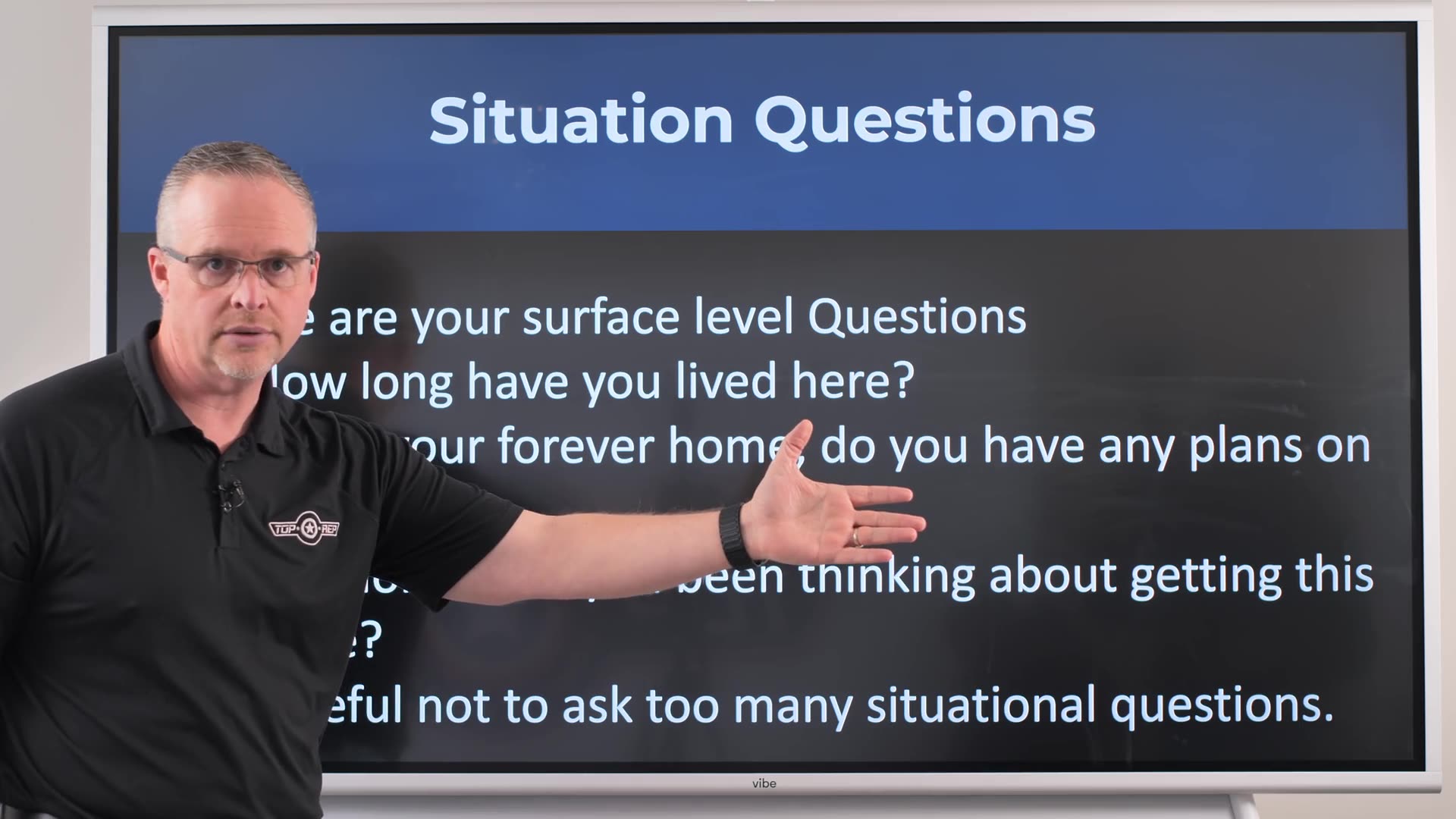
Step 1: Begin With Situation/Surface Questions
Start by establishing rapport and gathering basic information about the customer's situation. These questions help you understand their general circumstances.
• "How long have you lived here?"
• "Is this your forever home or do you have plans on moving?"
• "How long have you been thinking about getting this project done?"
Why this matters: These questions reveal critical context about timeframes, competing priorities, and the customer's commitment level. But don't stop here - this is just the beginning.
For example, when a customer tells you they've lived in their home for 12 years, follow up with: "What other home improvement projects have you done while you've been here?" This reveals their experience with contractors and their prioritization of home improvements.
If they just moved in, you might ask, "What other projects are you planning?" This helps you understand their priorities and identify what other trades might be competing for their budget.
Remember, asking about their plans for the home early in the conversation can save you from presenting the wrong solution. If a homeowner tells you they're planning to move soon, you'll approach the sale differently than if they're planning to stay for decades.
Understanding how long they've been thinking about the project is also crucial. When a customer admits they've been thinking about this for years, it makes it harder for them to say "I need to think about it" later when you present your solution.
While there are no perfect "objection defeating" questions (because customers often decide their objections before you arrive), these early questions can help you prepare for and potentially redirect common objections.
Step 2: Transition to Problem-Based Questions
Once you've established basic context, dig deeper into the specific problems they're experiencing.
• "Do you know when this started?"
• "Has this happened before?"
• "What problems are you experiencing in that area?"
• "What have you done to fix the issue?"
Why this matters: These questions help you understand the history and severity of the problem. They also reveal what solutions the customer has already considered or tried.
For example, when a customer mentions a leaking ceiling, ask when it started and what they've already tried to fix it. Their answer might reveal they've been researching solutions for months or have had repeated problems with temporary fixes.
A powerful question to add is: "What do you see as a solution?" This reveals what they've learned from "Dr. Google" and gives you insight into their expectations before you present your solution. Know what's on their sheet of paper before you show them what's on yours.
Step 3: Ask Solution-Based Questions
Once you understand their problems, transition to questions that help them envision the solution.
For roofing or insurance-based restoration, try: "Let's pretend that you are able to get this done for just a little bit more than the insurance is going to pay. Getting that lifetime roof, can you see the savings when you no longer have to pay a deductible after deductible?"
Why this matters: These "let's pretend" questions help the customer visualize the benefits of your solution and start mentally accepting the investment before you present pricing. You're marrying the solution to their problem and putting them into a future situation where they can experience the benefits.
Remember, great sales pros hold out on offering the solution until they've let the prospect share their pain and what they have done and why it didn't work.
Step 4: Use Clarifying Questions
When customers give you information, don't assume you understand everything. Use clarifying questions to ensure you're on the same page.
• "Can I ask you why you said that?"
• "Can I ask what you meant when you said...?"
• "Can I ask why you want that though?"
• "Would that possibly take some pressure off of you?"
Why this matters: Clarifying questions demonstrate that you're truly listening and trying to understand their unique situation. They also uncover deeper motivations that the customer might not explicitly state.
Step 5: Deploy Drill-Down Follow-Up Questions
The most powerful questions are often the simplest follow-ups. When a customer gives you an answer, dig deeper with:
• "Why though?"
• "Tell me more about that."
• "How did that make you feel?"
Why this matters: These follow-up questions take you from surface-level information to the emotional core of what's driving the purchase decision. Don't just stop at the main question - keep digging, keep drilling down to get to the root of what they need.
Once you get to the root of their needs, you might find a completely different solution is required, or gain understanding that will be crucial for closing the sale.
"But won't all these questions annoy my customers?"
Actually, the opposite is true. People appreciate being heard and understood. By asking thoughtful questions, you're showing genuine interest in their situation rather than rushing to pitch your product. Remember, our analysis of over 2 million sales conversations shows that top performers ask five times more questions and speak at half the speed of average performers. Customers don't want a fast-talking salesperson - they want someone who takes the time to understand their unique needs.
Example
Let's see this questioning framework in action with a roofing customer:
Surface Question: "How long have you lived in this home?"
Customer: "About 8 years now."
Follow-up: "What other home improvement projects have you done during that time?"
Customer: "We've updated the kitchen and bathrooms."
Follow-up: "How did those experiences go with the contractors?"
Customer: "The kitchen went well, but the bathroom contractor was a nightmare - always late and over budget."
Problem Question: "When did you first notice issues with your roof?"
Customer: "After that big storm last spring. We had a small leak in the guest bedroom."
Follow-up: "What have you done to address it so far?"
Customer: "We had someone patch it, but I'm worried it's just a temporary fix."
Clarifying Question: "Can I ask why you're concerned about that?"
Customer: "Well, I've read online that patching usually doesn't solve the underlying problem."
Follow-up: "What do you see as the ideal solution here?"
Customer: "I want something that's going to last and not cause more headaches down the road."
Solution Question: "Let's pretend we could provide a roofing system that comes with a lifetime warranty and eliminates these ongoing concerns. Can you see how that would save you from dealing with this problem again in a few years?"
Customer: "That sounds like what I need, but I'm concerned about cost."
Drill-Down: "Tell me more about that concern."
This conversation reveals not only the technical needs but also the customer's concerns about contractor reliability, long-term solutions, and budget considerations - all crucial information for tailoring your presentation and overcoming objections.
Wrapping Up
Remember, the Champion Sales Rep asks five times more questions than average performers, but speaks at half the speed. This isn't about rapid-fire interrogation - it's about thoughtful, strategic questioning that builds trust and uncovers true needs.
The question framework we've covered - moving from surface to problem to solution-based questions while using clarification and drill-downs throughout - is a proven system that our top performers use daily to close high-ticket sales.
In our next lesson, we'll build on this foundation and show you how to leverage the information you've gathered to present your solution in a way that makes price less relevant and positions you as the only logical choice.
Transcript
So now let's get into some questions that you need to ask. We have some trade partners that actually record everything that happens in a house. They go through it and then we have a whole analysis of what happened. Well, we have over 2 million of these recordings and what we have found with top rated sales professionals is that they ask five times more questions. But you've got to ask the right questions. It's not just they just ask random questions. They ask the right questions and they understand why they're asking these questions. The other thing that we know is that they speak half as fast. And so when we look at these questions, we have what we call situation or surface level questions. These will just get you started. Now what a lot of sales reps do is they just ask surface level questions and they never really dive in or dig in to the answers that they hear. They're so wrapped up and asking questions. They don't even listen to the answers. So the first one here is how long have you lived here? It's great when they tell you that they've lived here for 12 years. So a drill down question with that is great. So what other projects have you done while you've been here? Now if they say, oh, we just moved in. So what other projects do you, are you planning? These are things that you really want to know because if they have lived here for 12 years, they've had other projects, well, how did they go? What did you like about that process? What didn't you like about that process? These are things you really want to hear and dive into. Now if they just moved in and they say, well, we've got the ACs coming. We also are looking at getting the windows done. Now you know what you're up against. Your competitors aren't the people down the street. Your competitors are the other trades that they're looking to have done. The next thing here is, you know, is this your forever home or do you have any plans on moving? Don't wait until the end when you have gone through the best products that you have to find out they're just looking for something really cheap because they plan on putting this thing on the market next week. So is this your forever home or do you have any plans on moving? How long have you been thinking about getting this project done? This wasn't as big. Again, when you asked them how long they've been thinking about this and they say they were been thinking about this since we moved in five years ago at the end after you've given price, it's a little bit harder for them to tell you that they need to think about it when they've already told you they've been thinking about it for five years. Now there is no objection defeating questions. I know you've heard this before. It is total crap because of one thing. They have been thinking of these objections since they pulled in. Before you ever even showed up, it was a pact between the husband and the wife that they weren't buying anything that we need to let them know that we need to think about this. So it's not that we're objection defeating. We're just getting ready for any objections and trying to push it away if at all possible, but you better be ready for it. Some of them are so into this pact that they made that they don't care what they said prior. They're going to say it anyway. So you've got to be ready. Then we have problem-based questions. Do you know when this started? So if you're inside of a repair situation, I want to know when this started. If there's a leak in the ceiling, I want to know when it started. Has this happened before? What problems are you experiencing in that area? What have you done to fix the issue? This one is huge. The other one that's not on here that you can ask if they, you know, when you ask them, what have you done to fix the issue? Is what do you see as a solution? You know, have you ever heard of Dr. Google where they have been researching this problem on Google? It's just like the doctors. They get sick and tired. They prescribe you something. They tell you that this is wrong. And most of these patients will say, well, what Google says, yeah, tell me all about what Google says. So I want to find out what's on their sheet of paper before I tell them what's on my sheet of paper. Then we have solution-based questions. Now this one is mostly for the roofers. Let's say this is your insurance-based restoration. You know, John, let's pretend, I love doing this. Let's pretend that you are able to get this done for just a little bit more than the insurance is going to pay. Getting that type of lifetime roof. So now it's not just shingles. Maybe we're going to give them a lifetime roof. Getting that lifetime roof can you see the savings when you no longer have to pay a deductible after deductible? Now what I'm doing is let's pretend I'm putting him into a future situation. You know, this is where we marry the solution to the problem. Great sales pros hold out on offering the solution until they let the prospect share their pain and what they have done and why it didn't work before they bring the solution. So let's get into some easy clarifying questions. John, can I ask you why you said that? Can I ask what you meant when you said, can I ask why you want that though? Would that possibly take some pressure off of you? These are clarifying questions. Some are yes and no and we also want open-ended questions as well, but these are clarifying questions. You know, also you can go back and repeat what they said in the form of a question and they will elaborate that. But that's how you ask clarifying questions. So let's get into some drill down, some follow-up questions. Now we've already talked a little bit about follow-up questions. When they answer your question, then you can follow it up. You can drill it down to try and get the right down to the why. You write down to the root of what it is that they need. But here's a few here. Why though? That's easy. Why though? Tell me more about that. How did that make you feel? Don't just stop at the main question. Keep digging, keep drilling down. Because once you get to the root of it, you might find a whole different solution that needs to happen or understanding of how you're going to close this homeowner simply by understanding how to do drill downs.
⬇️ Click or Tap The Button Below ⬇️
To Test-Drive 'Flight School' For FREE And Get 3 Gifts!