
Question Based Selling
Price Orientation
Steps of the Sale
Closing Roadmap
Champion Sales Rep Crash Course
#2 : Price Orientation

Lesson Guide
◉ Introduction – The power of price presentation sequencing (0:00)
◉ Why "Good-Better-Best" fails (but "Best-Better-Good" wins) (0:17)
◉ The psychology of starting with premium options (0:45)
◉ How to position your "Good" option against competitors (1:35)
◉ The "Better" sweet spot strategy (2:15)
◉ Creating multiple price points for negotiation flexibility (2:45)
◉ Making your offerings easy to understand and affordable (3:35)
Action Guide
Best-Better-Good Pricing Framework: The Psychological Advantage
When presenting your pricing options to homeowners, the sequence and structure can make all the difference between a closed deal and a lost opportunity. This lesson breaks down our proven Best-Better-Good pricing strategy that helps customers see the value in your offerings and select the option that best fits their needs and budget.
By the end of this lesson, you'll understand how to structure your pricing presentation to maximize close rates and average ticket sizes without resorting to high-pressure tactics or competing solely on price.
Why Your Pricing Presentation Order Matters
Most home service companies get their pricing presentation completely backward. They start with their most affordable option (the "good") and work their way up to premium solutions. This approach immediately anchors customers on the lowest price point and makes your better options seem expensive by comparison.
When you present options in "Best-Better-Good" order instead, you create an anchor at the premium level first. Each subsequent option then feels like a deal by comparison, rather than an upsell from the base model. This shifts the customer's focus from "How little can I spend?" to "How much value can I get for my investment?"
This approach aligns with how customers actually think - they want the highest quality for the lowest price. By showing them the highest quality first and then working toward more budget-friendly options that still deliver value, you're working with their psychology rather than against it.
The 3 Biggest Mistakes When Presenting Pricing Options
Before diving into the proper framework, let's address common pricing presentation mistakes:
1. Starting with your lowest option first: This anchors customers to the lowest price point and makes your premium options seem unnecessarily expensive.
2. Having only one price point: Without options, you have nowhere to go when customers say your price is too high - except home without the sale.
3. Failing to differentiate your options clearly: Without clear distinctions between options, customers default to choosing based on price alone.
How To Master The Best-Better-Good Pricing Framework:
Step 1: Present Your BEST Option First
Start by presenting your premium solution. Detail all the benefits, features, and protections this option provides.
Why this matters: Starting with your best option anchors the customer to the highest value and price point. Everything that follows will be compared to this premium standard.
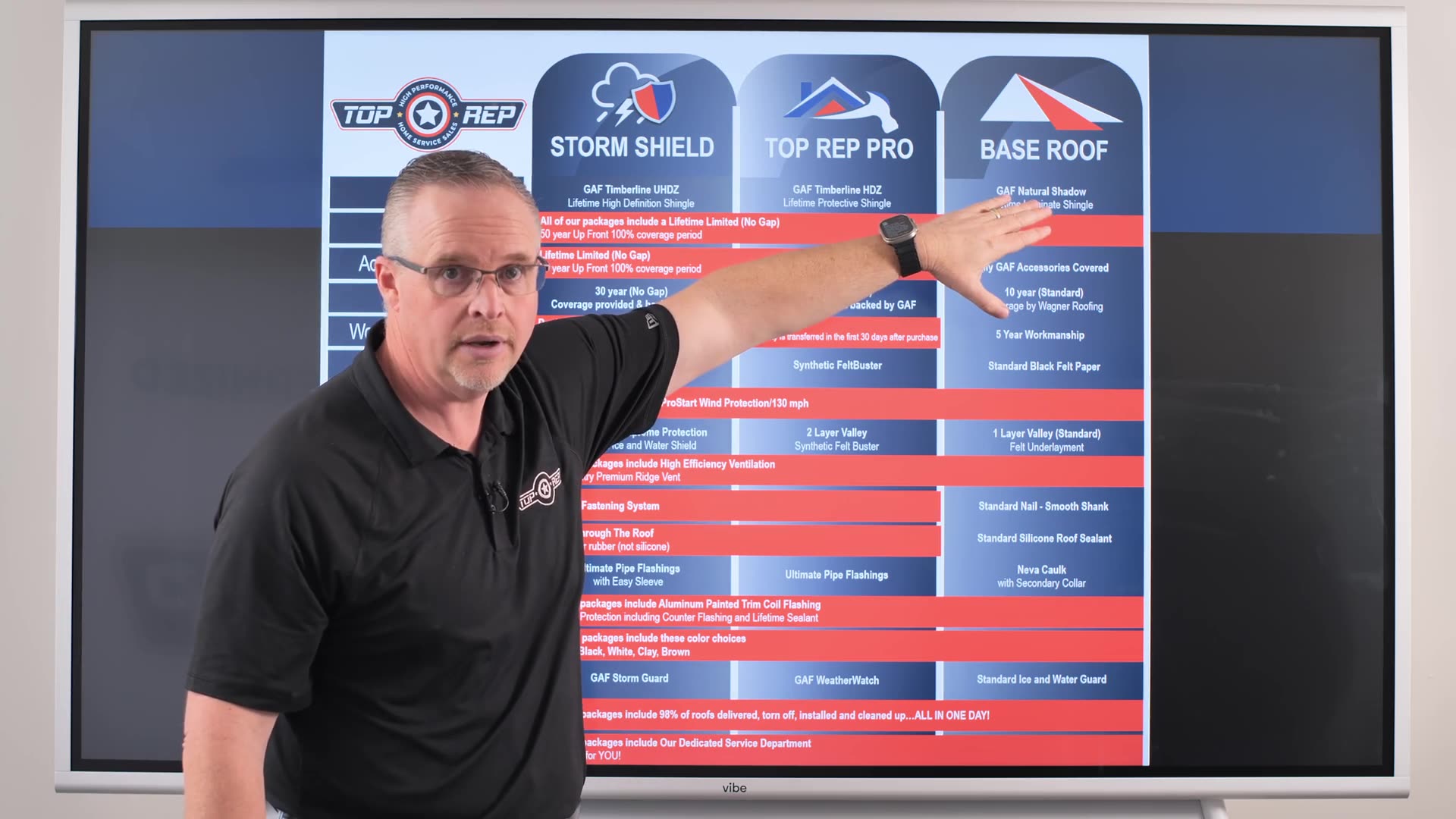
For example, if you're selling roofing, present your "Storm Shield" premium roof system first. Detail every high-end feature, extended warranty, and enhanced protection it offers. Don't hold anything back - really blow them away with the quality and comprehensive protection of this option.
After fully presenting this premium solution, reveal the price. Let the customer absorb this price point as the anchor against which they'll compare everything else.
Step 2: Skip to Your GOOD Option (Base Model)
After presenting your premium option, skip your middle option temporarily and jump straight to your entry-level solution.
Why this matters: This creates maximum contrast between your premium and basic offerings, highlighting what customers would miss by choosing the lowest-priced option.
Position this option as "how we compete with all the contractors in town." This subtly suggests that this is what your competitors are offering - nothing special, just the basic solution that will need to be replaced sooner.
For example: "This is our base roof system. This is how we compete with all the other contractors in town. I'm sure you've had a few people out who've presented something similar. It's your typical 'I'm going to change this out in another 10 years' type of roof."
By framing it this way, you're effectively throwing your competitors in the trash while positioning even your entry-level option as comparable to what others are selling.
Step 3: Introduce Your BETTER Option as the Sweet Spot
Now reveal your middle option as the perfect compromise between premium features and affordability.
Why this matters: After seeing both the premium and basic options, many customers will naturally gravitate toward a middle option that feels like the best of both worlds.
Frame this option as the solution to their dilemma: "What we have found over the years, Bob and Mary, is that most people really want the durability and protection of the best, the Storm Shield, but more towards the comfort of being able to afford the base roof. Thus, the Pro was born."
Highlight the key features this option shares with your premium offering, while emphasizing that the price is much closer to your base model. This makes it seem like an obvious choice or "no-brainer."
Step 4: Present Multiple Price Points for Each Option
For each package option, show at least two price points:
- The regular "retail" price
- A special "today" or "30-day" price
Why this matters: This gives you room to negotiate without cutting into your margins. When a customer objects to your price, you already have a lower option to offer without compromising on the selected package.
Always start with the retail price, then move to any time-limited promotional pricing. This creates a built-in incentive to decide sooner rather than later.
For example: "The retail price for our Pro system is $X. However, if you decide within the next 30 days, we can offer it for $Y. And if you decide today, we can do it for $Z."
This approach gives you multiple opportunities to close the sale at different price points while maintaining the perception of value.
"But what if I only offer one product solution?"
Even if you only offer one product solution, such as a custom bathroom remodel, you should still present multiple price points. You can break down the comprehensive scope of work first, then present your retail price followed by any special pricing offers.
The key principle remains the same: always have at least two price points to work with. If you only have one price and the customer says it's too expensive, you have nowhere to go but home without the sale. With multiple price points, you have built-in flexibility to work with customer objections.
Example
Let's see the Best-Better-Good framework in action with a roofing presentation:
BEST Option (Storm Shield Premium Roof)
"Let me show you our Storm Shield system. This is our premium solution that includes enhanced impact resistance, advanced weatherproofing, and comes with a lifetime transferable warranty. The materials are top-of-the-line and designed to withstand severe weather conditions while maintaining their appearance for decades. The retail price for this complete system is $32,000. For customers who decide within 30 days, we offer special pricing of $29,500."
GOOD Option (Base Roof)
"Now, this is our Base Roof system. This is how we compete with all the other contractors in town. I'm sure you've had others present similar options. It includes standard shingles with a 10-year warranty and basic installation. This is your typical roof that you'll likely need to replace within a decade. The retail price for this is $18,000, with our 30-day price at $16,500."
BETTER Option (Pro Roof)
"What we've found over the years is that most homeowners really want the durability and protection of the Storm Shield, but with a price point closer to the Base Roof. That's why we developed our Pro Roof system. It includes many of the premium features of the Storm Shield, like enhanced wind resistance and a 30-year warranty, but at a price point much closer to our Base Roof. The Pro Roof is available at a retail price of $24,000, but our 30-day price is $21,500, and if you decide today, we can do it for $20,000."
Notice how the middle option now seems like the obvious choice - it offers significantly better features than the base model but at a price much closer to the entry-level than the premium option.
Wrapping Up
The Best-Better-Good pricing framework is a powerful psychological tool that helps customers select options based on value rather than just price. By anchoring high, creating contrast, and offering a compelling middle option, you make it easier for customers to say yes to a solution that truly meets their needs.
Remember the key principles:
- Always start with your premium option
- Create maximum contrast by jumping to your basic option next
- Position your middle option as the perfect compromise
- Have multiple price points for negotiation flexibility
In our next lesson, we'll explore how to handle objections that arise during the pricing presentation and turn hesitation into commitment.
Transcript
So when you're presenting price, you can do a best better good. Maybe you have a solution that's more of a design build and it's just going to be one price. So if that's the case, if you have a design build, say it's a bathroom, most bathrooms, sometimes windows, you are only going to have one price. And so therefore what you're going to do is go through the entire scope of work and then you're going to come up with the price itself, the retail price. But if you're going to come into a three product where you're going to do a best better good and here it is, do not do good better best. If you do good better best, it's going to get, it's going to go from bad to worse. But now when you're doing best better good, you have the opportunity to start at the top, really blow them away and then get better where they, because what they're looking for, they're looking for the highest quality for the lowest price. So show them the highest quality for the lowest price if you know what I mean. So what we're going to do is we're going to start right here with our best and we're going to drill all the way down to help them to understand then we're going to blow them away with the price of the best. For us, it's our storm shield. And then we're going to flip over to the base, whether it's the base roof, the base coating, whatever it is, we're going to come all the way over. We're going to skip the better to go to the good. And this is, we're going to tell them that this is how we compete with all the contractors in town. What I'm doing is throwing everybody else in the trash. This is how we compete with all the contractors in town. And I make this sound exactly like everybody else that's been out. I'm sure that you've had a few people out that have had this. And they're just kind of nodding. They're like, yeah, okay. So that's your typical, I'm going to change this out in another 10 years type of roof. And they're like, okay, that makes sense. But what we have found over the years, Bob and Mary, is that most people really want the durability and protection of the best, the storm shield. But more towards the comfort of being able to afford the base roof, thus the pro was born. And I'm going to show the similarities here that are very similar to here, but this price is a lot closer to this price. All of a sudden, it's a no brainer. So this is why we use a best, better good. And that's how you do it. It makes it a lot easier. And when you're giving price, put the retail price down. And then you're going to go down to the 30 day. Now you may only have a 30 day. So you start the 30 day and then if you want, or if you can, you go down to the today price. But here's what I want you to understand. You should always have at least two prices. I'm doing this because you have your retail and your today price. If you only have one price and it's your best price, where are you going to go? Home, because that's all you got. But if you have two prices and you give them your retail price, where are you going? You can go down to your today price when they tell you you're too expensive here. So it makes things a lot easier. If you really want to dive in and find out how to give this price, jump in to the platform, ask us how to get into the platform. We'll get you in and you'll find out exactly how to give a price effectively. So that homeowner, that homeowner, sees everything as just easy to understand and they can afford anything. If you make it easy enough, they'll buy anything. If you make it look affordable, they'll buy anything. That's the whole process by how we give a price.
⬇️ Click or Tap The Button Below ⬇️
To Test-Drive 'Flight School' For FREE And Get 3 Gifts!