

Question Based Selling
Price Orientation
Steps of the Sale
Closing Roadmap
Champion Sales Rep Crash Course
#4 : Closing Roadmap

Lesson Guide
◉ Intro – Understanding the closing roadmap framework (0:00)
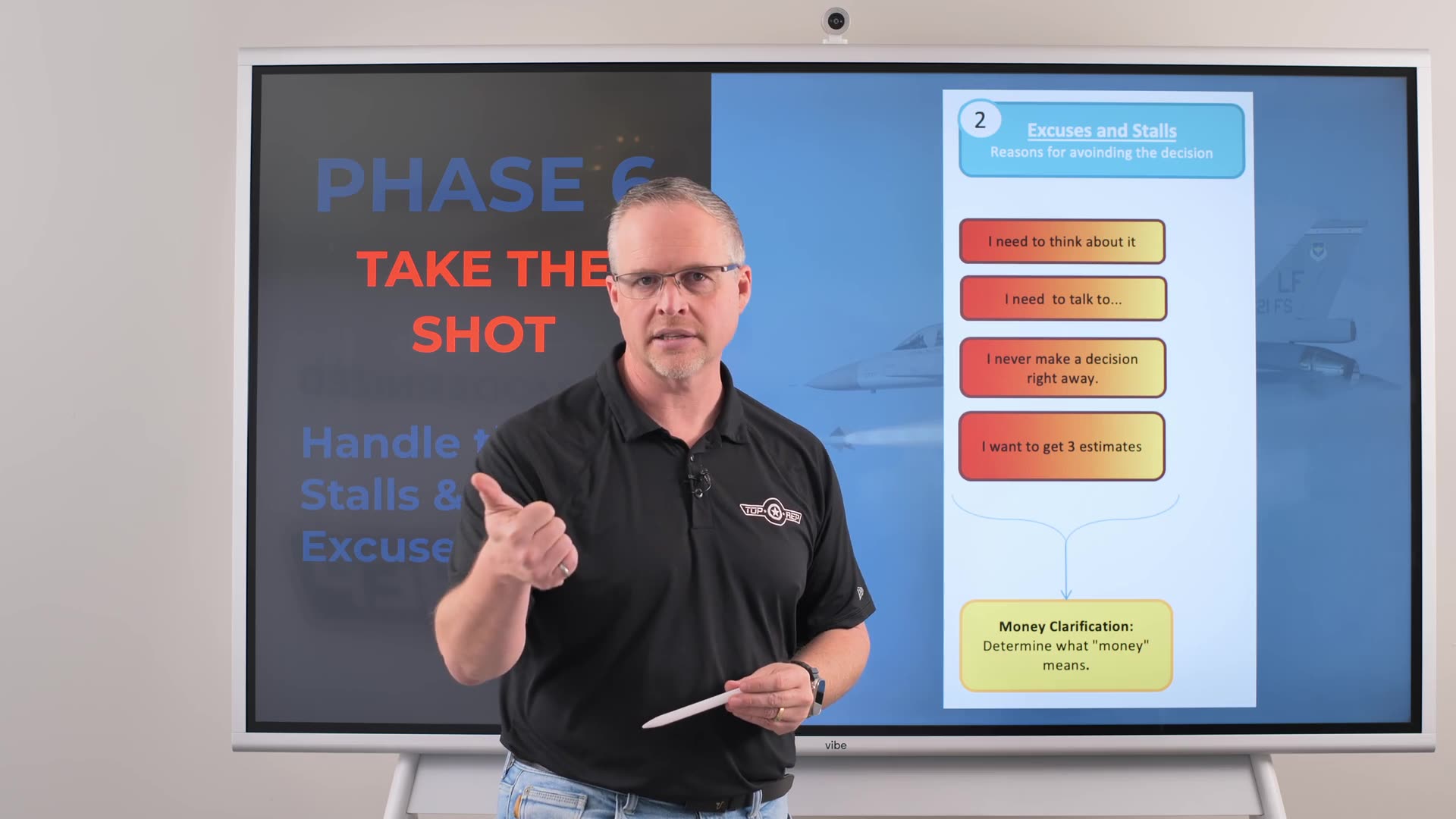
◉ Why all objections lead to money (0:30)
◉ The "I need to think about it" response (1:07)
◉ Handling "I need to talk to someone else" objections (2:22)
◉ Managing "I never make decisions right away" responses (4:38)
◉ Overcoming the "I need three bids" objection (5:34)
◉ Breaking down money objections: Value vs. Affordability vs. Timing (8:05)
◉ Specific techniques for addressing value concerns (8:40)
◉ Solutions for affordability objections (9:40)
◉ Turning timing concerns into closed deals (10:34)
◉ Why mastering this system requires practice (11:33)
Action Guide
The Champion's Closing Roadmap: Turning Objections Into Sales
Every sales presentation eventually reaches the critical moment where the customer must decide whether to move forward. This is where most average sales reps falter, but Champion Sales Reps thrive. This lesson breaks down our proven Closing Roadmap that has helped our sales professionals convert more appointments into signed contracts.
By the end of this module, you'll have a clear framework for handling every common objection, stall, and excuse that homeowners use to delay making decisions. You'll discover how to systematically guide conversations toward the true objection and close more deals without high-pressure tactics.
Why A Closing Roadmap Is Essential
Many sales reps dread objections, viewing them as roadblocks to closing the sale. But what if objections were actually stepping stones to the sale? Our data shows that the most successful sales professionals don't avoid objections - they anticipate them and have a systematic approach for addressing each one.
The Closing Roadmap does exactly that - it gives you a clear path to navigate the final stages of the sale, regardless of what objections arise. Instead of scrambling for responses or feeling defeated when objections arise, you'll recognize them as familiar territory and know exactly how to proceed.
When you understand that all objections ultimately lead to money - and you have a proven system for addressing money concerns - you'll find that closing becomes the easiest part of the sales process rather than the most stressful.
The 3 Biggest Mistakes When Handling Objections
Before diving into our proven framework, let's address common mistakes that kill deals during the closing phase:
1. Taking objections personally: When homeowners object, many reps become defensive or disappointed, which creates tension and damages rapport at the critical moment.
2. Accepting the first objection at face value: The initial objection is rarely the true concern. Without proper follow-up, you'll be addressing a surface issue while the real objection remains hidden.
3. Lacking a systematic approach: Improvising responses to objections leads to inconsistent results. Without a proven roadmap, you'll miss opportunities to turn objections into closed deals.
How To Master The TOP REP Closing Roadmap:
Step 1: Recognize That All Objections Lead to Money
The foundation of our Closing Roadmap is understanding that all objections, stalls, and excuses eventually lead to money. Once you've isolated money as the only concern, closing becomes straightforward.
Many sales reps fear hearing "It's too expensive," but this objection actually simplifies your job. The customer has already moved past all other potential concerns and identified price as the only issue - now you just need to address that specific concern.
Our Closing Roadmap helps you systematically move every conversation toward money clarification, where you can determine if the concern is about value, affordability, or timing - each of which has a specific solution.
Why this matters: Understanding that all roads lead to money simplifies the closing process and gives you clarity on exactly what needs to be addressed to move forward.
Step 2: Handle the "I Need to Think About It" Objection
When a customer says, "I need to think about it," respond with: "I totally understand, Bob. When you say you need to think about it, how long do you feel you need?"
When they give a timeframe (typically a few days to a week), point out that your 30-day price gives them plenty of time to decide. Then ask two critical questions:
- "Is this the system you want on your roof/in your bath?" (Confirm product selection)
- "Is our company the one you feel would do it right the first time?" (Confirm company selection)
Once they confirm both, say: "So when that time comes, the only thing that will stand between you and I will be the money, right?"
This approach isolates price as the only real concern, allowing you to move to money clarification: "Typically when someone says it's the money, it's one of three things: value (you don't see what we're asking is worth it), affordability (you don't know where the money will come from), or timing (you're waiting for funds to become available). Which is it for you?"
Why this matters: This technique acknowledges their need to think while simultaneously narrowing the discussion to the real issue - usually money. It also establishes that your 30-day price protection gives them the time they need.
Step 3: Address the "I Need to Talk to Someone Else" Objection
Whether it's younger homeowners needing to talk to parents or older homeowners consulting with their adult children, this objection follows a similar pattern:
1. Offer to include them: "I understand completely. Let's get them on the phone. I know they'll have questions."
2. When they say the person isn't available: For younger homeowners, say "If hypothetically we couldn't reach them for three months and we need to get this done, how do YOU personally feel about spending $X on this project?"
For older homeowners consulting adult children, use: "You know, my parents do the same thing. When this happens, I always ask them three questions: Will this solve your problem? Do you trust the person sitting in front of you? Can you afford it?"
3. After getting agreement and completing the paperwork: "Now I know you're about to call your son/daughter. How do you feel that conversation is going to go?" (This acknowledges the conversation will happen, but doesn't try to coach them through it.)
Why this matters: This approach respectfully acknowledges the importance of the other person while gently helping the homeowner recognize their own decision-making authority.
Step 4: Counter the "I Never Make Decisions Right Away" Response
When homeowners say they never make decisions on the spot or need to sleep on it, respond with:
"Bob, I totally understand. Other than the fact that you need a night, which I completely understand, hypothetically if I was able to do something with these two numbers (pointing to down payment and monthly payment), would that potentially help with your decision-making process?"
This appeal to curiosity almost always gets them to ask what you could do, instantly bringing the conversation back to money - exactly where you want it.
Why this matters: This technique respects their process while offering a specific incentive that might override their usual decision-making pattern.
Step 5: Overcome the "I Need Three Bids" Objection
This common objection requires a more comprehensive approach:
1. Concede and clarify: "I totally understand. When do you think these other people are coming out?" (Get their timeline)
2. Ask about selection criteria: "When you have all your bids on the table, what criteria will you use to pick which contractor you'll go with?"
3. Reframe around value, not just price: When they inevitably mention price, respond: "Is price the only thing you're worried about? I'm sure I could get a couple buddies and a case of beer to get this done cheap." (This usually gets a laugh and acknowledgment that quality matters too.)
4. Establish value as the true goal: "So what you're really looking for is the highest quality for the lowest price - in other words, value, right?"
5. Remind them of your value guarantee: "Remember our price and value guarantee? If you find someone who does exactly what we do, exactly how we do it, for less than what we charge, we'll refund the difference plus give you $100."
6. Ask the closing question: "If the investment is fair and flexible, what does another contractor have to tell or show you that we haven't already told and shown you? Would it be crazy to just get this taken care of and not have to worry about it anymore?"
Why this matters: This comprehensive approach acknowledges their desire to comparison shop while demonstrating that your company has already done the research for them, eliminating the need for multiple bids.
Step 6: Address Money Objections Directly
Once you've isolated money as the concern, determine which of the three money issues is at play:
For Value Objections ("It's just way too much"):
1. Ask what "too much" means to them (as everyone has a different definition)
2. If it's truly a value issue, ask "Before I came out, how much did you think this would be?"
3. Then follow with "After seeing everything I've shown you, where are you now?" (They'll often meet you halfway)
4. Finally, ask "So it looks like we're only about $X apart. How long will it take you to come up with the rest?" (Then be silent)
For Affordability Objections ("I just don't know if I can afford that"):
1. Determine if it's the monthly payment or down payment causing concern
2. If it's the monthly payment: "If $450 is more than you can afford, how much could you afford?" (Get their number)
3. If it's the down payment: "How much could you afford to give us today?" (Get a partial down payment with a plan for the remainder)
For Timing Objections ("We need to wait for our tax return"):
1. Get their timeline: "When do you expect to receive those funds?"
2. Confirm intent: "So if I was sitting in front of you after you received that money, we'd be doing business, right?"
3. Offer a solution: "If there was a way I could get this done now, and you don't need to pay anything until you get that money, would that interest you?"
4. Present your financing option with deferred payment: "We have a trade partner that allows us to do just that."
Why this matters: Breaking money objections into these three categories allows you to apply the specific solution that addresses the real concern, rather than using a generic approach that might miss the mark.
"But won't pushing through objections make me seem too aggressive?"
This approach isn't about being pushy or aggressive - it's about helping homeowners clarify their true concerns and providing solutions. Notice that the language is collaborative and understanding: "I totally understand," "Let me see if I can help," and similar phrases maintain rapport while moving the conversation forward.
Remember that most homeowners want to solve their problem but may need help working through their decision-making process. By systematically addressing their concerns rather than accepting surface-level objections, you're actually providing better service - helping them get what they want without unnecessary delays or additional appointments.
Example
Let's see how this process works in a real scenario with a roofing customer:
Homeowner: "This looks good, but I need to think about it."
Sales Rep: "I totally understand, Bob. When you say you need to think about it, how long do you feel you need?"
Homeowner: "Probably until the end of the week."
Sales Rep: "That's why we give you 30 days. You'll definitely be able to make a decision within that timeframe. Let me ask you - is this the roofing system you want for your home?"
Homeowner: "Yes, I like the system."
Sales Rep: "And do you feel our company would do the job right the first time?"
Homeowner: "Yes, you seem very professional."
Sales Rep: "Great! So when that time comes, the only thing that will stand between us will be the money, right?"
Homeowner: "Well, yes, I guess so."
Sales Rep: "Typically when someone says it's the money, it's one of three things: either value - you don't see what we're asking is worth it; affordability - you don't know where the money will come from; or timing - you're waiting for funds to become available. Which is it for you?"
Homeowner: "Well, it's just more than I was thinking it would be."
Sales Rep: "I understand. Before I came out, how much did you think this would cost?"
Homeowner: "I was thinking around $15,000, and you're at $22,000."
Sales Rep: "And now that you've seen everything our premium system includes, especially the extended warranty and enhanced ventilation system, where are you at now?"
Homeowner: "I could probably go to about $18,000."
Sales Rep: "So it looks like we're only about $4,000 apart. How long will it take you to come up with the rest?"
Homeowner: "Well... I suppose I could do it if the monthly payments were manageable."
Sales Rep: "Great, let me show you a financing option that would keep your monthly payment under $300. Would that work for your budget?"
Wrapping Up
The TOP REP Closing Roadmap provides a systematic approach to handling every common objection, stall, and excuse you'll encounter during the sales process. By understanding that all objections ultimately lead to money - and knowing exactly how to address value, affordability, and timing concerns - you'll close more deals without resorting to high-pressure tactics.
Remember, mastering this system requires practice. You can't just listen to this lesson and expect to implement it perfectly. You need to commit these responses to memory, practice them until they become second nature, and apply them consistently in your sales appointments.
In our next lesson, we'll explore how to build a Champion Sales Team by training other reps to implement these same successful methodologies, allowing you to scale your sales operation without sacrificing quality or results.
Transcript
So this is our closing road map. This is what most people hire us for is understanding how to close. We want you to have an easier way to understanding all the stalls, excuses and objections that you're going to get in the house. So these are all of your stalls and excuses and as you can see we are going to go ahead and bring this down to money right here, money clarification right there. So no matter what happens here we're boiling it down to money. Once we get it to money I can close anything and you might be thinking man I hate it when people tell me that it's too expensive. I love it because they've already done my job for me. I don't have to go through this step. They've already jumped me all the way over here to the objections and all I got to do is take care of it and sell them. So here's how we deal with the stalls, excuses and objections. These are excuses and stalls. The first one here is I need to think about it. Hey I totally understand bomb and you know when you say you need to think about it how long do you feel like you need to think about it. Oh wow to the end of the week. Well that's why we give you 30 days. Obviously you're going to be able to make that decision within the 30 days. That's fantastic. And so you know is this the system that you want on your roof? Is this the system you want in your bath? Yes great. And are we the company? Is Top RepExperience the company that you feel would do it right the first time? Awesome. And so I'm guessing that when that time comes I'm putting distance between me and the homeowner. When that time comes the only thing that's going to stand between you and I it's going to be the money right. They say yes. We took it to money right here. Money clarification. And then when we take it to money is hey you know typically when somebody says it's the money it's one of three things. It's either value you don't see pain what we're asking. It's affordability. You just don't know how where that money is going to come from or maybe it's timing. You're waiting for a tax return of bonus or something like that. Which is it for you? I can deal with all three of those. Now I need to talk to maybe they need to talk to their dad. It's a younger couple or a younger female. They're very first house and they need to talk to their dad. Hey I totally understand. You know and so you know let's let's get him on the phone. I know he's got questions. Let's get him on the phone. And they tell you that they can't get him on the phone. He's a trucker. He never seems to be able to talk. And so I'm like ah okay. Now let's just say that hypothetically that he's on an island. We can't get a hold of him for the next three months. We got to get this thing done. You know how do you personally feel about spending $10,223 on this project? Yeah that's that's a lot of money. We just kicked daddy out and we're taking care of the situation. Maybe it's a an older couple and they they tell you that they need to talk to their son or daughter. They need to talk to their kids. Now first of all make sure that this isn't a POA or power of attorney situation. There's not much you can do there. But most of the time they just want to run it by their kids. And so hey let's go ahead. Let's get him on the phone. I know that he's got questions. And they're going to tell you oh we can't get him on the phone. You know he's all the way out in California wherever he's working right now. We're not going to be able to get him on the phone. You know what my parents do the same thing to me when this ever happens. When they're getting their housework done. And I always ask them the same three questions Bob and Mary. So the first one is you know will this solve your problem? Yeah okay. And do you trust the person sitting in front of you and I'll give him a smile. This is typically when they offer me my second glass of water. And then the third one is you know can you afford it and shut up? You know this right here and it may go one way or the other but typically this is when they're like you know what you're right it's my money I do with it however I please and let them buy. And then after you've gotten the contract filled out they gave you the check you got to bring up. Hey so now I know that you're about to call your son or however you're going to take care of that. How do you feel that conversation is going to go? All you're doing is letting them know that that conversation is about to be had. You do not coach them through it. The next thing here is I never make a decision right away. This one's easy. So when they say oh you know we need to sleep on it we never make a decision right away. Bob I totally understand it and other than the fact that that you need a night which I totally understand you know hypothetically if I was able to do something with these two numbers and I'm pointing to the down payment monthly payment and I don't care if you have just one or the other and maybe it's just the down payment or just the monthly payment. If I was able to help you out with these two numbers with that potentially help you with your decision making process it's funny because curiosity kills the cat every time when they look at it like what could you do now we're back to money again it's that easy you're starting to see this now just how easy this is so I know that everybody's been looking at the last one there. I need to get three bids the homeowner tells you that they have a couple more people coming out and so you have to be ready for this one this one's a little bit longer to understand and so when someone tells you that they have other bids coming out you have to concede say hey I totally understand and and when do you think these other people are coming out when they say all they're going to be here within you know the next seven seven to ten days they'll be here by next week okay great and let's say that in the next seven to ten days you have all your bids you're going to put them all on the table what criteria are you going to use to pick which contract you're going to go with and they may look at you and say well it's going to be price so is price the only thing you're worried about I'm sure that we can get this price way down I'm sure I can get a couple buddies and a case of beer we can get this thing done cheap and they might laugh a little bit maybe hold the whole case of beer thing but again they might laugh a little bit and say hey look it you know you know let's just say that what you're looking for is the highest quality for the lowest price and they're like yeah so let's just say that it's value that you're looking for right oh yeah and so you know when the fact that we're looking at value I want you to understand one thing and that is that you're always going to be able to find somebody that can do it cheaper however you're going to be really hard pressed to find somebody that can do it cheaper and still be able to do it right the first time do you remember me talking about our price and value guarantee and they're like yeah that was really cool and the fact that you can go ahead and get this thing taken care of now and that you can go ahead shop us out and if you find somebody does exactly what we do and exactly how we do it and they can do it for less than what we can then what we're going to do is refund you the difference plus give you a hundred dollars for the fact that you went out and found somebody that we haven't found yet that that was really what you were looking for right and like yeah and do you think that we could put our money where our mouth is if we haven't already done our homework if we haven't already done the research now I guess not so if the investment is fair and flexible what does another contractor have to tell you or show you that we haven't already told and show you like I really don't know so would it be a crazy idea to just go ahead get this thing taken care of and not have to worry about it anymore this works we've been doing it for over 20 years that works again we're going to take everything to money so now when we get everything to money now we're going to either do with value affordability of timing so when it comes to value you're probably going to hear this oh man it's just way too much well when you hear it's way too much what does that mean to you if there was a 10 of you just so you know that everybody would have a different answer so when someone says you're too much you got to ask him well how do you mean I want to know what what too much means you might find out that it's really timing or affordability but if they do come in and they say well it just really is just more than what we were thinking so now I have to step them up okay and the short way of doing this is quite simply asking them so before I came out how much did you think this would be and when they're like well yeah I thought that you know you're at 20 I thought this is going to be closer to 10 okay and after I came out and I showed you and I'm going to go through a lot of the technology upgrades and some of the other stuff that might make us different where are you now and it's funny where a homeowner will come up halfway oh well I could probably come up to 15 okay so it looks like we're only about $5,000 a part yeah so how long will it take you to come up with the rest and shut up you'd be shocked with what they say now maybe affordability I mean I just don't know if I can afford that okay so is it the monthly payment or is it the down payment that's causing you an issue if they say it's the monthly payment well so if 450 is a little bit more than what you were able to afford how much could you afford three three fifty you know that should get into their ballpark they may come up with maybe two or two fifty but make sure that when you make the suggestion that you can actually hit those suggestions if they say well it's really going to come down to the down payment there's no way that I can come up with 10,000 right now I'm going to have to move some money around okay so how much could you afford to give us today I could probably give you about 2000 okay and would you be able to give us the other eight in the next week yeah I can probably do that so you still want to get your company's down payment but get some teeth today make sure that you get something before you leave and of course timing you know when you find out that you know they're they got all these these other issues and right now you're probably getting well we need to wait for our tax return okay so when do you feel like you're going to get this tax return man we'll probably get that tax return in April okay so what you're telling me is that if I was sitting in front of you in May and you'd gotten that tax return and it was enough to pay for this that we'd be doing business right now yeah okay and I really look forward to this let me ask you if there was a way that I could go ahead and get this done now and I don't need anything from you until you get that money would that be of any interest to you and I mean that would be wonderful but how would you do that well we have a trade partner that allows us to do just that and therefore you know if you qualify then I don't need anything from you when you get that money I don't need anything from you until today of next year I want to make this investment so affordable for you that it's the most affordable investment you make all year do you have your drivers license on you that's how easy this is but you need to make it easy by learning it you can't just listen to me and say man that guy really knows the stuff you have to learn it you have to put it in place and you have to be a top rep now get into the platform go ahead click on the QR code that you see here and jump into the platform let's dive in and let's get a little bit deeper on your success I'll see you at top rep
⬇️ Click or Tap The Button Below ⬇️
To Test-Drive 'Flight School' For FREE And Get 3 Gifts!