

Question Based Selling
Price Orientation
Steps of the Sale
Closing Roadmap
Champion Sales Rep Crash Course
#3 : Steps of the Sale

Lesson Guide
◉ Intro – The importance of a systematic sales process (0:00)
◉ Pre-appointment preparation (0:14)
◉ Initial impression and entry strategy (0:35)
◉ Establishing rapport: The F.O.R.M. method (3:17)
◉ Setting expectations with your entry statement (4:20)
◉ Strategic questioning during the survey phase (6:53)
◉ The inspection: Your opportunity to differentiate (8:43)
◉ The company sandwich presentation technique (11:53)
◉ Trial close and price presentation strategies (12:52)
◉ Managing drops and objections with confidence (14:19)
Action Guide
The Champion Sales Process Roadmap
The most successful sales professionals understand that selling high-ticket home services isn't about luck or natural talent - it's about following a proven, repeatable process. This lesson breaks down our comprehensive roadmap for the sales appointment, from preparation through closing, that has generated over $1.2 billion in home service sales.
By the end of this lesson, you'll understand each critical step in the TOP REP Sales System and have a clear framework for conducting professional, high-converting sales appointments that close more deals at higher average tickets.
Why Following a Sales Process Matters
Many sales reps approach each appointment differently, relying on gut instinct and improvisation. This inconsistent approach leads to inconsistent results. The data shows that top-performing sales professionals follow a structured, repeatable process for every appointment.
A defined sales process accomplishes several critical objectives:
1. It gives you confidence and eliminates the guesswork about what to do next
2. It ensures you gather all the information needed to present the right solution
3. It builds credibility through a professional, polished approach
4. It positions you as a consultant, not just another salesperson
5. It prevents critical steps from being skipped in the excitement of the moment
Think of it like a doctor's visit: you wouldn't trust a physician who skips the examination and jumps straight to prescribing medication. Similarly, homeowners trust sales professionals who follow a thorough, professional process that demonstrates expertise and care for their specific situation.
The 5 Biggest Mistakes Sales Reps Make During Appointments
Before diving into our proven process, let's address the most common mistakes that kill sales opportunities:
1. Poor preparation and arrival: Being late, looking disorganized, or not knowing basic information about the appointment creates a negative first impression that's difficult to overcome.
2. Rushing through rapport-building: Jumping straight to business without establishing trust and understanding the customer's situation makes you seem like "just another salesperson."
3. Failing to set proper expectations: Not outlining what will happen during the appointment creates uncertainty and puts the homeowner on edge.
4. Conducting a superficial inspection: A cursory look at the problem area fails to demonstrate expertise and misses critical information needed for an effective presentation.
5. Presenting price without building value: Revealing the investment before establishing the full value of your solution makes price the main focus rather than the benefits.
How To Master The TOP REP Sales Appointment Process:
Step 1: Entry and Warm-Up
Your appointment begins before you even arrive. Preparation is crucial - ensure all electronic devices are charged, review any notes about the homeowner, and know exactly where you're going.
Call the homeowner 15 minutes before arrival to confirm they're ready. When you arrive, park appropriately (in the driveway but not blocking the garage) and exit your vehicle promptly - the homeowner is likely watching through a window or doorbell camera.
Walk with purpose to the door, knock or ring the bell, then take a couple of steps back. When the homeowner answers, use their name twice: "Bob? Yes, Bob, my name is Chuck. I'm here with TOP REP. Is now still a good time to spend the next 60-90 minutes with me?"
Confirm they have enough time set aside and ask about your parking. Then offer to put on booties before entering - a small touch that shows professionalism and differentiates you from other contractors.
Why this matters: These first moments set the tone for the entire appointment. A professional, prepared approach immediately elevates your status from a typical contractor to a trusted advisor.
Step 2: Build Rapport with F.O.R.M.
As you enter, casually observe the home environment for conversation starters - look for signs of hobbies, children, or interests. Use the F.O.R.M. method to establish genuine rapport:
- Family: Ask about their family situation
- Occupation: Discuss their work (this reveals much about how they make decisions)
- Recreation: Explore their hobbies and interests
- Motivation: Transition back to the purpose of your visit
This information helps you understand who they are and tailor your approach accordingly. For example, an engineer might need more technical details, while a teacher might respond better to educational analogies.
Why this matters: People buy from people they trust. Genuine rapport-building shows you care about them as individuals, not just as potential customers.
Step 3: Set Expectations with Your Entry Statement
After establishing rapport, transition to business by asking, "By the way, Bob and Mary, did the people on the phone tell you what to expect from us today?" Regardless of their answer, this gives you the perfect opportunity to narrate what will happen during the appointment.
Your entry statement should outline the entire process:
- First, you'll ask questions about their situation
- Next, you'll examine the problem areas (inside and outside as needed)
- Then you'll conduct a thorough inspection
- After that, you'll share information about your company and solution
- Finally, you'll provide a price down to the penny so they can make an informed decision
End with "Fair enough?" to get their agreement on this process.
Why this matters: Setting expectations reduces anxiety and creates a framework for the appointment that positions you as organized and professional. It also subtly establishes that providing a price is part of the expected process.
Step 4: Conduct Your Survey with Strategic Questions
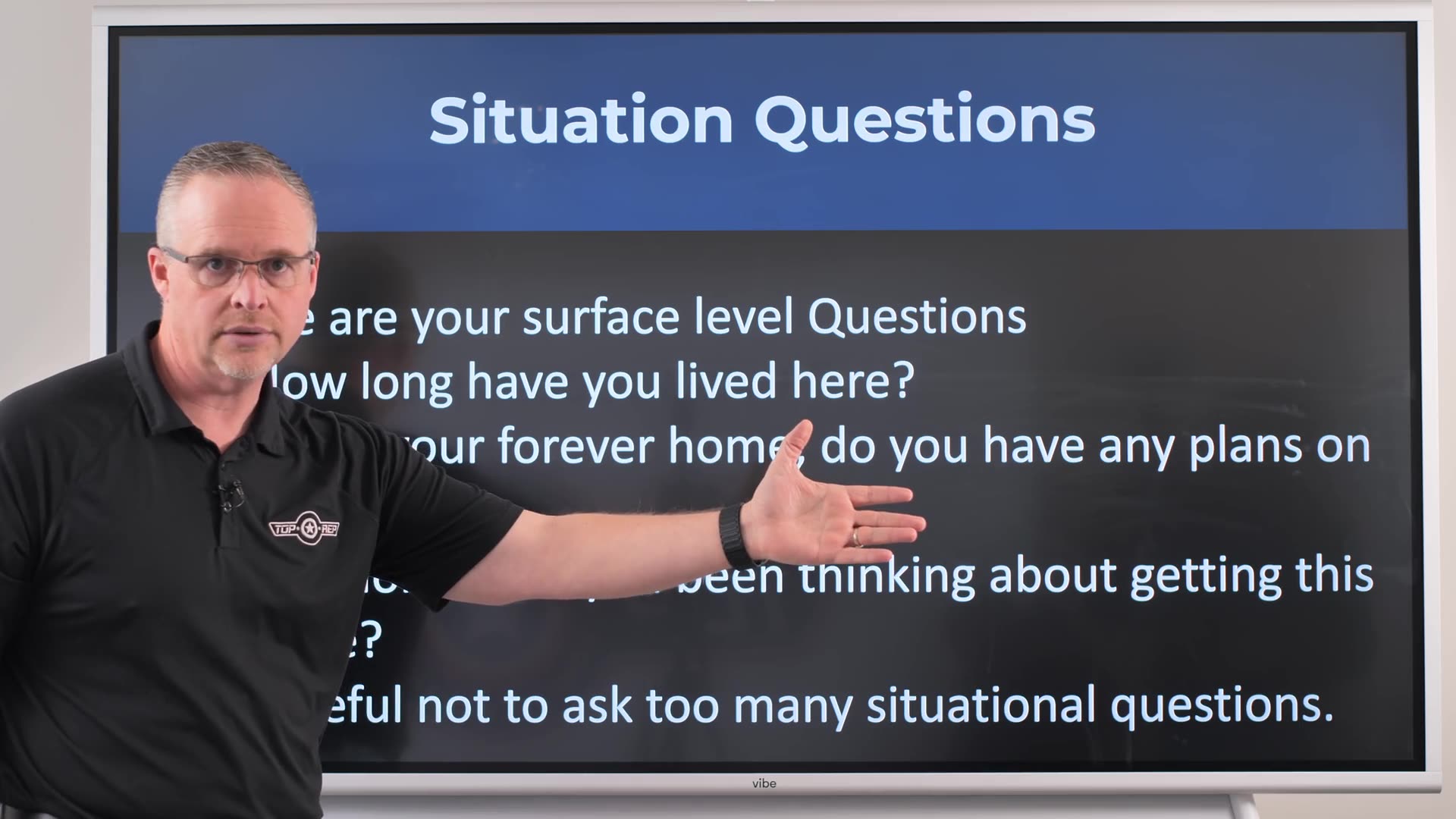
As you transition into the survey phase, begin asking the surface-level questions we discussed in our previous lesson about questioning techniques:
- "How long have you lived here?"
- "Is this your forever home or do you have plans on moving?"
- "How long have you been thinking about getting this project done?"
Remember to use drill-down questions to dig deeper into their answers. When they mention previous home improvement projects, ask how those experiences went.
This reveals their expectations and potential concerns about working with contractors.
Why this matters: These questions help you uncover their true needs, timeline, and decision-making process. The information gathered during this phase will be crucial for tailoring your presentation and overcoming objections later.
Step 5: The Inspection - Your Selling Opportunity
The inspection is where you truly differentiate yourself from the competition. Have the homeowner show you the problem areas, letting them explain their concerns in their own words.
For roofing appointments, examine both interior issues (including the attic) and exterior concerns. For bathroom remodels, have them share their vision for the space - ask if they have pictures or ideas saved on their phone before showing your options.
During your inspection:
- Go further than your competition (e.g., checking the attic when others won't)
- Look professional (tool belt for roofers, proper measuring tools for bath remodels)
- Document thoroughly (take pictures, measurements, and notes)
- For roofing, record a concise 2-3 minute video explaining your findings (longer videos lose attention)
Why this matters: A thorough, professional inspection demonstrates your expertise and builds trust. This is where you truly sell the job - the remaining steps just confirm the decision that begins forming during this phase.
Step 6: The Company Sandwich Presentation
When you return to the table, share your inspection findings first, then transition to your presentation using the "company sandwich" approach:
- Begin with what makes your company special and different
- In the middle, cover the product details and technical aspects
- End with more unique company advantages and guarantees
This structure ensures that when you present the price, the customer is thinking about what makes you different rather than just comparing you to other contractors based on price alone.
Why this matters: This presentation structure emphasizes your unique value proposition both before and after discussing product details, making price less of a deciding factor.
Step 7: Trial Close and Price Presentation
Before presenting your price, use a trial close to isolate price as the only potential objection: "Bob and Mary, is there anything other than the money that would keep you from jumping onto our production calendar while I'm here?"
When they confirm that price is the only concern, say: "Great, give me a couple of minutes to work up your investment."
When presenting price:
- Project absolute confidence in your pricing
- Cover all aspects of what's included in the investment
- Present your best/better/good options (if applicable)
- Always include financing options with your initial price presentation
- Provide a "30-day price" before revealing any additional discounts
Your emotional intelligence is crucial here - if you don't believe in your price, neither will the customer. Present with confidence and conviction.
Why this matters: The trial close eliminates non-price objections before the price is presented, while a confident, value-focused price presentation minimizes price resistance.
Step 8: Handle Objections with Predetermined Drops
When objections arise, be prepared with predefined, authorized price adjustments (or "drops"). These should be systematically applied rather than randomly offered:
1. First, sell your 30-day price with financing options
2. If needed, introduce a free upgrade to add value
3. As a final option, present a marketing agreement or today-only price
Once your final price is presented, that's it - there should be no further negotiation. Having predefined drops ensures consistency and maintains price integrity.
Why this matters: Random, unstructured discounting damages the credibility of your pricing and trains customers to negotiate harder. A structured approach maintains professionalism while still providing flexibility.
"But won't this structured process seem too rehearsed?"
Not at all. When mastered, this process feels natural and conversational. Think of it like a great basketball player who practices the fundamentals until they become second nature. During the game, they're not thinking about their dribbling technique - they're focused on reading the defense and making the right play.
Similarly, mastering this sales process allows you to focus on the homeowner's specific needs rather than wondering what to do next. The structure becomes invisible to the customer while guiding you toward consistent success.
Example
Let's see this process in action with a roofing appointment:
Preparation and Arrival: You review the lead details, call 15 minutes before arriving, and arrive precisely on time. You park in the driveway, promptly exit your vehicle, and approach with confidence.
Entry and Warm-Up: "Mr. Johnson? Yes, Mr. Johnson, I'm Chuck with TOP REP Roofing. Is now still a good time to spend about 60-90 minutes together to look at your roof situation?" After confirmation, you ask about parking and put on company-branded booties before entering.
Building Rapport: As you enter, you notice golf clubs in the entryway. "Do you get out on the course often? I've been trying to improve my game this summer." This leads to a brief, genuine conversation about local courses before transitioning back to business.
Setting Expectations: "By the way, did our team explain what to expect today? Let me quickly outline our process. First, I'll ask some questions about your situation and any issues you've noticed. Then we'll look at any interior problems and walk around the exterior. After that, I'll perform a complete roof inspection with photos and video so you can see exactly what I see without having to climb up there yourself. Once we're done, I'll explain our company's approach and provide an exact price so you can make an informed decision. Fair enough?"
Survey Phase: "How long have you lived in this home?" (Answer: 7 years) "What other home projects have you tackled during that time?" (Answer: Kitchen remodel last year) "How did that experience go with the contractor?" This reveals their expectations and previous experiences.
Inspection: You examine interior water damage, check the attic (noting inadequate ventilation), then have them walk you around the exterior to point out visible issues. You put on your tool belt, climb to the roof, and conduct a thorough inspection, recording a concise video explaining your findings.
Presentation: Back at the table, you show your inspection video and photos, then present your company's unique approach using the company sandwich. You highlight what makes your company different before and after explaining the technical aspects of the roofing system.
Trial Close and Price: "Mr. and Mrs. Johnson, based on everything we've discussed, is there anything other than the investment amount that would prevent you from moving forward today?" (Answer: "No, we just need to know the cost.") "Great, give me a moment to work up your investment options."
You present your best/better/good options with confidence, starting with the premium option, then showing the basic option, and finally presenting the middle option as the perfect balance of quality and affordability. Each includes both the retail price and 30-day special pricing with financing options.
Wrapping Up
The TOP REP Sales System provides a comprehensive roadmap for every step of the sales appointment. By mastering this process, you'll approach each appointment with confidence, gather the right information, present your solution effectively, and close more deals at higher average tickets.
This systematic approach is what separates Champion Sales Reps from average performers. It's not about natural talent or luck - it's about consistently executing a proven process that builds trust, demonstrates value, and guides homeowners to make confident decisions.
In our next lesson, we'll dive deeper into the closing roadmap and explore exactly how to handle the most common objections that arise during the price presentation phase.
Transcript
Now's a good time to talk about the steps of the sale that we are going to teach you in this crash course. The first step that we look at is our entry in warm-up. Now during your entry in warm-up, it starts the day prior. We really want to make sure that your sales reps are ready for that appointment. And making sure that all of their electronics are charged, make sure they know where they're going and make sure that they know who they're going to be visiting. Now when they get to the customer's house, they need to get there on time. They should not be pulling up five or ten minutes late. And it's not a bad idea to have them call fifteen minutes before they get there so that that homeowner is ready for them. Now when they pull up, it's not a big issue if they pull up and they park on the street. But they have to pull into the driveway, just make sure they don't go all the way up to the garage door that they leave some space. Now when they go and get out of their car, they have thirty seconds to get out of their car. That homeowner is either recording them or watching them on some sort of ring doorbell, some kind of digital doorbell device. So we want to get out of our car as soon as possible. When they get out of the car, make sure that they walk up with a little bit of swagger that they have some purpose in their step so that when they reach the door, they knock on the door, ring that doorbell and they take a couple of steps back. Make sure that your sales rep knows what to say when that door opens. Now for us, we want to make sure that we repeat their name twice. So when that homeowner answers the door, I know their first name. I know either the wife or the husband's first name. And so when they answer the door, it's like, Bob, yes, Bob, my name is Chuck. I'm here with Top Repix Steereers. Is now still a good time to spend the next 60 to 90 minutes with me. I want to make sure that they have, it's already set aside enough time for me to have a proper appointment. And once they say, yeah, yeah, absolutely, we have that time. Great. And is it okay where I parked? Yeah, everybody's in for the night. Great. Do you mind if I go ahead and put on some booties before I come in? And I'm going to take them out of my back pocket and put those surgical booties on my feet. Now there's a reason why we don't always just take off our shoes. That means that everybody takes off their shoes or should take off their shoes. And we want to be a little bit different. And so we'll typically get booties that are colored for our company, blue, red, whatever. And so we're going to put those surgical booties on and we're going to come into the house. Now during this time, I'm going to kind of glance around the house. You don't focus about what's going on. It's almost like you're casing the place. But I am going to take and glance around the house and see if do they have kids? Do they have different hobbies that might be out? Maybe you're going to walk by a set of golf clubs, anything. Something that you can have a conversation about that doesn't pertain to your trade, whether it's baths, roofs, siding, something like that. That way you can get on a different level with that homeowner before you really get into it. We have a thing called form. Some of you have already heard of this from other trainers, but form stands for family occupation, recreation, motivation. And so I'm going to talk a little bit about their family, get to know their family a little bit. Really, and when I get into their occupation, this tells me a lot about who they are. If they're an engineer, if they're an accountant, if they're, you know, any, you know, maybe they're a teacher, it tells me a lot about who they are. And when we get into their recreation, also tells me a little bit about who they are. They like to have fun, or maybe they're too busy to really have much of a life. And so some of you already know what that's like. And so, you know, then we get into motivation. And motivation means that we're just going to go right back into it. And so I want to get to a kitchen table, if at all possible. But most importantly, I want to get to a place that they are comfortable sitting down and having a conversation. And once we get there, then after I've had a little bit of back and forth conversation, I'm going to bring it back to business. And how we do this is, by the way, Bob, Mary, you know, the people on the phone, did they tell you a little bit about what you could expect from us today? And they're looking and say, I'm not quite sure if they did or not. Hey, no problem. Now I'm going to get into narrating what's going to happen today. This is our entry and warm-up statement. So Bob, Mary, the first thing that I'm going to do is I'm going to have you kind of explain to me, you know, what has happened with your roof? Do you have any leaks? Should we be looking at anything on the inside of the house before we walk outside? And I'm also going to be asking questions. This is where we get into our survey. I'm going to be asking surface-level questions throughout this time. While they're walking me around the house, while they're walking me through the inside of the house to show me any leaks that they might have. Or obviously, if we're going to be looking at the bathroom, that's a good time to be asking some, quote, surface-level questions as well. And so at this point, you know, I'm going to go through that entry statement. Bob and Mary, so, you know, the first thing I'm going to do is I'm going to ask you some questions. I'm going to have you walk me through the house to show me any leaks or issues that you might have. And then I'm going to have you walk me around the outside of the house so that you can show me why we're here. You know, if there's any issues that you have noticed that has made you call us out, I want to take a look at those. And then from there, I'm going to jump up on your roof. I'm going to do a full roof inspection. You know, if you're a bath company, I'm going to, I'm going to have you walk me into the bath and show me exactly why we're here. And so during this process, you're trying to get them to tell you exactly what made them call you. And then Bob and Mary, I'm going to jump up on your roof. I'm going to do a full roof inspection complete with over 50 to 60 pictures, but also I'm going to take a 4K video of the roof inspection so that you don't have to come up there with me. I'm going to bring that roof down to you. And once we're done with that, I'm going to tell you a little bit about who we are and our solution to your issues. But most importantly, I'm going to leave you with a price right down to the penny so that you have an opportunity to make an informed decision. Fair enough, I'm going to get them to agree that this is exactly why they called us out and this is why they called our company out. And once we get done with that, then it's the opportunity to go through a lot of these questions, these surface level questions. This is what we call our survey. And when we go into our survey, I'm going to ask them, so how long have you guys lived in the house? And they might say that all we just moved in, or they might also say, well, we've been here for 12 years. Well, now I'm going to drill down. When I drill down with the homeowner, now it's time to get into some of these questions that actually means something. You know, asking them how long they've lived here is not going to sell you the job. But now we have that opportunity to ask them drill down questions. And so Bob and Mary, you guys have lived here a while. What other projects have you done around the house? And they might bring up, you know, that they just redid the kitchen, they did fence, they, whatever it might be, maybe they just redid their siding. And is that something that you used another contractor for? They're like, yeah. And how did that process go? You're going to start drilling down. Instead of having this list of questions and you're pinpointing the list, now it's time to make it a conversation. I'm also going to ask, so is this your property that you're going to live in for a while? Or is this a property that you plan on selling in a few years? You know, they mentioned that, oh, we're going to be leaving here feet for us. Great. That's fantastic. And then we're going to get into more surface level questions, similar to, so how long have you guys been thinking about getting this project done? And when they say, oh, we've been thinking about this for two or three years. Wow. Okay. And, you know, what makes you guys decide to go ahead and move forward with this today? Oh, no, we're not doing anything today. Oh, really? Well, what makes you say that? And I'm not going to get into that any further. This is just information that we're going to use at a later time. And the next thing is to get them to walk us around the house. Now this is typically used during roofing. If you're in, in baths, we're not going to have them walk me around the house. We're going to get right to the patient, if you will. That is the inspecture. But for roofing, I want them to walk me around the inside. If there are any issues going on inside, I want to get up into the attic. Getting up into the attic is done to allow us to be different from anybody else. Nobody knows that they're supposed to get into the attic, but most people don't. And so you getting up into the attic is going to differentiate you from anybody else. Getting them to walk you around the house. This is where they get to tell you why you're there. Things that they have noticed, whether there's damage, whether there's issues going on on the roof, for whatever reason that they have you there, that that's going to give you the information you need to create that urgency. For the most part, they're going to create their own urgency by walking you around the house. Then it's time to get up on the roof. This is the inspection. So once we get up on the roof, you must look like a roofer. If you're just going to jump up there with a pair of khakis and a golf shirt and a cell phone, that is not a roofer. Make sure that you have your tool belt on. Make sure that they know what's in the tool belt and how to use those tools. Then while you're getting up on the roof, that you're going to take a bunch of pictures, but you are going to go through a video and make sure that you've done your inspection. You know what you're going to cover because you only have two and a half minutes to do that video. Once you get past two and a half minutes, the homeowner, once they're watching this thing, they're going to start glazing over. So you have two and a half minutes to get that everything that you're going to cover with that homeowner on that video. Now, if you are in, let's say, bats, you know, we're going to go into the bath area and we're going to ask them to paint us a picture of what they want. Maybe they have a picture in their phone, a Pinterest or something like that that they can show you. Make sure that they show you what's on their sheet of paper before you start showing them what's on your, showing them what's on your sheet of paper. And so I want to take a look at what their vision is for that space. The next thing is is you want to go further than anybody else inside that inspection. So while you have them, that you are going to measure their hip. This is where you're going to put most grab bars. This is also where you might put the handle for the or the faucet. You know, any of that stuff for the bath area. And once you get into our program, you're going to get a lot more that we do during the inspection. That makes this inspection so much different than anybody else's. And it's where you sell the job. And I don't care what trade that you are in. This is where you sell the job. Now, once you get back to the table, this is where you're going to show that roofing video. This is where you're going to show any of the videos that you might have done as well as showing the pictures. But once you get back, this is the opportunity to show them why you're different. We get to show them our presentation. And what we do with our presentations and inside of our platform, we'll actually show you what that presentation looks like and how it should flow and how you actually cover that presentation. But when you put your presentation together, we have what we call the company sandwich. So the company information, the company story sandwich. So you want a little bit about the company upfront and you want it in the back. Everything in the middle is everything that is going to be similar between you and everybody else. And so when we first start out, we want what's different with the company. And when we finish, we want what's different with the company. So that when they're ready to make that decision, once you show them the price, that what they're thinking of now is everything that makes you special. Everything that makes you different. And once you're done with that presentation, then you're going to slide right in to the trial clothes. Now this isn't new. This is something that has been going on for over 20 years, which is understanding that we are going to bring this down to money. So Bob and Mary, is there anything other than the money that would keep you from jumping on to our production calendar while I'm here? That's as easy as it has to be. And then from there, when they say, no, other than the money, other than affordability, everything looks really good. Great. So give me a couple of minutes to work up your investment. And so that, because what you're going to do right now is get everything ready. You're going to get whether you're going to do a best, better good, whether you just have one price to give them. But now it's time to move towards that price presentation. Now when you are doing price, you really have to bring confidence. This right here is one of the most important times to bring emotional intelligence out. That your emotions, the way that you present your price, is one of the most important things that you do. Because that's when the homeowner is watching you. That if you don't believe in your price, then they don't believe in it either. And so bring that pricing to them. But make sure that you make everything look like art. You can't just say, with everything that we talked about, it's going to bring you right down to this. No, you have to cover everything that's going to be inside of that investment. And so that when you give this investment, that if you have drops that you are ready for those drops. Now those of you that are watching this and that you are a manager or leader, make sure that you have defined drops and defined pricing. You cannot give too much autonomy to your sales reps. Because what's going to happen is they're going that the homeowner is going to lose confidence in your price. Because the sales reps tend to play with the pricing in the house. So they should be very scripted on how they deliver price. Now when you deliver your first price, you must, you must put financing with it. You know, whether it's a 30 day price that you're going to try and sell them on. And then you give them that opportunity. We always give them that 30 day cushion so that we can get anything from the homeowner that we need. Whether it's objections, maybe it's stalls and excuses that they've planned on already using against you. And now those opportunities come and you should know how to deal with those. And once those come in, then you teach and train your sales reps how you're going to allow them to bring in whether it's a free upgrade. Maybe what you're going to do is bring in a marketing agreement. And that marketing agreement allows so much off. But you have to sell the 30 day price and that financing before the upgrade or that marketing agreement comes out. Once that marketing agreement comes out and you have your today price, then games over. Once that price comes out, that game is over. You cannot justify your price anymore. And so that should be the opportunity for your sales reps to sell the job. Then from there, we're going to get into the closing road map, which we're going to cover next.
⬇️ Click or Tap The Button Below ⬇️
To Test-Drive 'Flight School' For FREE And Get 3 Gifts!